
Students from Old Dominion and GWU Selected as Co-winners of SERC Boehm Award
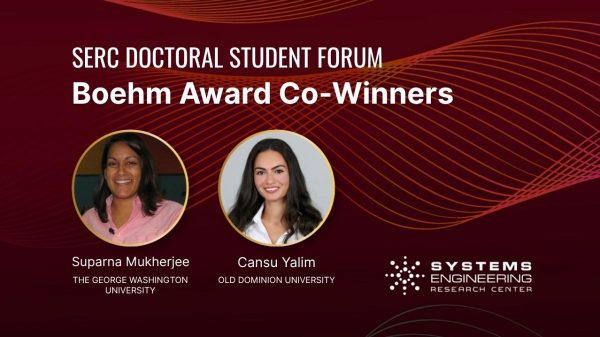
The 13th annual SERC Doctoral Student Forum (SDSF) took place April 8 during the 2026 Conference on Systems Engineering Research (CSER), held at the George Mason University campus in Arlington, VA. Each year, doctoral students from SERC collaborating universities are selected to present their work to an audience of thought leaders from academia, industry, and government. Including the SDSF as part of this year’s CSER agenda showcased the work accomplished across the SERC network and SERC’s commitment to cultivating an innovative brain trust able to address transdisciplinary challenges now and in the future.
Five invited doctoral students delivered presentations on their research, and a panel of judges consisting of SERC leadership members selected Suparna Mukherjee (The George Washington University) and Cansu Yalim (Old Dominion University) as the forum co-winners and recipients of a monetary prize and the Dr. Barry Boehm Award for Doctoral Student Research Excellence.
SERC Chief Scientist Dr. Zoe Szajnfarber presented the award. “As usual, all of the students did a great job and these were some of the best presentations at the conference,” said Dr. Szajnfarber.
Ms. Mukherjee’s presentation, “Improving Architectural Design Processes for Complex Systems,” described the development of a novel system representation for architectural design studies and how overall system complexity can grow as it is decomposed. She is currently a PhD candidate in Systems Engineering at The George Washington University. She received her master’s from Columbia University in Applied Physics and holds dual undergraduate degrees in Mathematics from New York University and in Mechanical Engineering from Stevens Institute of Technology. Her current research interests include complex system design, technology innovation, and infusion processes.
What is the significance of having had the opportunity to present?
“Presenting my work to active researchers was exciting and valuable. I am expecting to finish my dissertation this year, so the questions people asked provided useful feedback – both on the content of the work and what aspects are interesting to different research communities. [Also, preparing to present] my work in a way that would be understandable to a broader audience (outside my research group!) was great motivation.”
What is the significance of being selected as a co-winner?
“I am at a crossroads with what avenue I want to take post-PhD. Getting this visibility in the broader community could help me find that next step. This [opportunity] has added to my thinking on doing more research going forward. It’s good to know that folks are interested in my research interests, and that the work could be useful to academic and practitioner communities.”
What excites you about the SE field and/or about going forward with your research and contributing to the field?
“I was driven to pursue a PhD in systems engineering by the patterns in outcomes and behaviors I saw while working in industry. Participating in a PhD program, I have learned how much knowledge there is within the SE and SE–adjacent academic communities, and across different industries. I am excited about pulling the academic and practitioner pieces together to drive more meaningful and useful research, as well as development of tools and practices to help systems architects and engineers across industries.”
Ms. Yalim’s presentation, “Operationalizing Do-Calculus in Non-Stationary Fault Root Cause Diagnosis with Segmented TV DBNs,” presented Pearl’s do-calculus as a useful tool for real-world industrial applications where system dynamics change over time. She is pursuing her PhD in Engineering Management and Systems Engineering at Old Dominion University, where she also serves as a graduate research and teaching assistant. Her current research includes reframing industrial root-cause diagnosis as a causal inference problem and overcoming the correlational limits of traditional ML by integrating time, causal structure, and system dynamics to deliver trustworthy fault attribution in complex, changing environments.
What is the significance of having had the opportunity to present?
“Presenting meant a lot since research usually grows in silence. You spend years thinking, doubting, testing, and refining, and most of that process is invisible. The chance to present gave all of that quiet work a voice and a place in the room.”
What is the significance of being selected as a co-winner?
“It felt like one of those moments that makes time fold in on itself. You feel the present, but you also feel every long day that led to it. It was meaningful not just as an award, but as a sign that difficult, deeply technical work can connect, resonate, and be seen.”
What excites you about the SE field and/or about going forward with your research and contributing to the field?
“What excites me most is that systems engineering does not look away from complexity. It asks us to engage with messy, high-stakes problems and still reason clearly, act responsibly, and make better decisions. I want to keep pushing my research forward to contribute work that helps us move from observing failure to understanding it enough to intervene confidently.”
The Boehm Award, renamed in 2022 in memory of the late first SERC chief scientist, recognizes the best research presentation delivered by a doctoral student on the basis of potential impact, advancement to SE, originality, technical content, and clarity of presentation. The award additionally recognizes Dr. Boehm as a champion for the value of doctoral student work.
Dr. Szajnfarber noted that each year, the breadth and quality of submissions to the SDSF continue to illustrate the high caliber of systems work being executed by the next generation of SE leaders. This year, the following five doctoral students presented their work:
- Shahab Aref, George Mason University: Method for Data-driven AI Airspace Collision Risk Modeling
- Matthew Beigh, The George Washington University: Managing Critical Supply Chains Under Disruption: The Case of the 2022 Infant Formula Crisis
- Suparna Mukherjee, The George Washington University: Improving Architectural Design Processes for Complex Systems
- Balaji Rao, Stevens Institute of Technology: Autoformalization for Systems Engineering
- Cansu Yalim, Old Dominion University: Operationalizing Do-Calculus in Non-Stationary Fault Root Cause Diagnosis with Segmented TV DBNs
Follow SERC on LinkedIn for regular updates on systems engineering research.