
SERC Hosting Special Events for CSER 2026
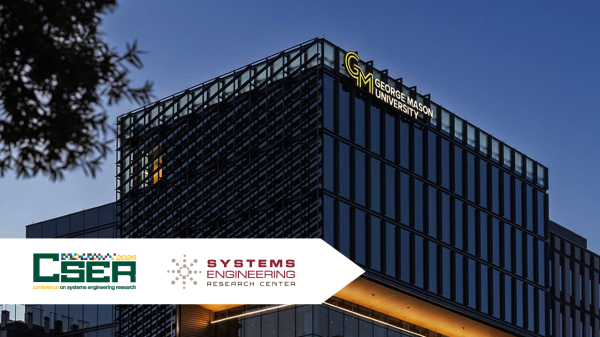
As part of the Conference on Systems Engineering Research (CSER) on April 6-9, SERC will host two special events, including a workshop for faculty interested in conducting research for the government, and the SERC Doctoral Student Forum.
Conducting Research with the Department of War
April 6, 10am-12pm
SERC leadership will host this interactive workshop designed for academic faculty who are curious about or new to working with the federal government. Participants will gain insight into the unique research landscape, explore opportunities for funding, understand how to engage with technical points of contact, and learn how to align research ideas with defense priorities.
The workshop is an add-on ticket to general CSER registration. Follow the CSER website agenda for the room assignment. For topical questions on the workshop, contact SERC CTO Tom McDermott.
SERC Doctoral Student Forum
April 8, 1:30pm-5pm
This forum had been postponed since last fall as part of the SERC Annual Events series. At CSER, five doctoral students will compete for the Dr. Barry Boehm Award for Doctoral Student Research Excellence:
- 1:30pm: Shahab Aref, George Mason University, “Method for Data-driven AI Airspace Collision Risk Modeling”
- 2pm: Matthew Beigh, The George Washington University, “Managing Critical Supply Chains Under Disruption: The Case of the 2022 Infant Formula Crisis”
- 2:30pm: Suparna Mukherjee, The George Washington University, “Improving Architectural Design Processes for Complex Systems”
- 3:30pm: Balaji Rao, Stevens Institute of Technology, “Post Training LLM Alignment, Formal Methods, Natural Language Processing, Knowledge Graphs”
- 4pm: Cansu Yalim, Old Dominion University, “Operationalizing Do-Calculus in Non-Stationary Fault Root Cause Diagnosis with Segmented TV DBNs”
Follow the CSER website agenda for the room assignment.
Additional Technical Presentations
Several SERC researchers contributed to technical presentations on the agenda, including:
- April 7, 10:30am: Dr. Nicole Hutchison, Virginia Tech, “BRIDGE: A Context-Aware Framework for Benchmarking Digital Transformation in Systems Engineering”
- April 7, 11am: Dr. Alejandro Salado, University of Arizona, “Exploring Similarity Assessments of LLM-generated Requirements”
- April 7, 1:30pm: Dr. Laura Freeman, Virginia Tech and Dr. Zoe Szajnfarber, The George Washington University, “Characterizing the Behavior of AI-enabled Socio-Technical Systems: What does a Testbed Need to Be?”
- April 7, 2pm: Dr. Nicole Hutchison, Virginia Tech, “Augment, Don’t Automate: Designing LLMs to Support Systems Engineering Teams”
- April 7, 2pm: Dr. Alejandro Salado, University of Arizona, “Translations of Semantic Paths through Embedding Registration”
- April 7, 2:30pm: Dr. Paul Wach, Virginia Tech, “Foundations for Systems Engineering: Exploring System Morphisms”
- April 7, 3:30pm: Dr. Bryan Mesmer, The University of Alabama in Huntsville, “Preliminary Results in Aggregating Multiple Value Estimates for System Optimization”
- April 7, 5pm: Dr. Azad Madni, University of Southern California, “Anticipating System Behavior with Intelligent Digital Twins: Lessons and Guidance for Collaborative Systems Engineering”
- April 7, 5pm: Dr. Alejandro Salado, University of Arizona, “Swarm Intelligence for Generalist Agents Coordination in CSAR missions”
- April 7, 5pm: Dr. Zoe Szajnfarber, The George Washington University, “Comparative Risk Mitigation in High-Risk, Low Harm Industries”
- April 8, 10:30am: Dr. Zoe Szajnfarber, The George Washington University, “Beyond time and efficiency: How Human-AI Architecture Shapes System Behavior”
- April 8, 11am: Dr. Alejandro Salado, University of Arizona, “Collaborative Intelligence: From Alignment to Ethical Co-Agency”
- April 8, 1:30pm: Dr. Alejandro Salado, University of Arizona, “Large Language Models for Systems and Ontological Modeling: Fine-tuning and Evaluation”
- April 8, 2pm: Dr. Bryan Mesmer, The University of Alabama in Huntsville, “Lifecycle-Integrated Digital Twin Verification: A Dual-Axis Evaluation Framework Using the Validation Fidelity Ladder (VFL) and Integration Maturity Model (IM²)”
Some presentations may be given by co-authors instead. Follow the CSER website agenda for room assignments.
Follow SERC on LinkedIn for regular updates on systems engineering research.