
7th AI4SE & SE4AI Workshop Highlights Collaboration and Governance
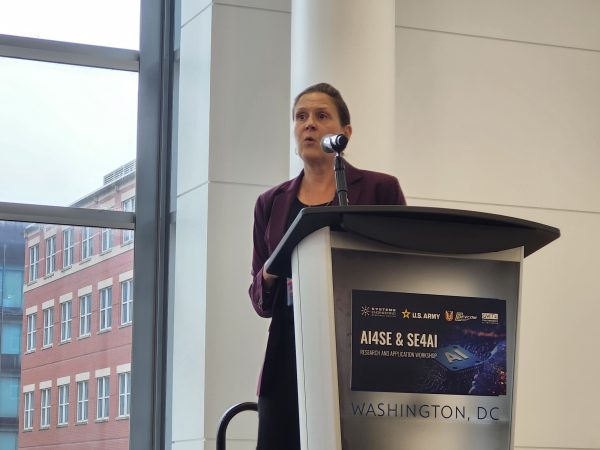
The seventh annual AI4SE & SE4AI Research and Application Workshop, held on September 22-23, gathered SERC researchers and interested attendees to discuss the convergence of systems engineering (SE) and artificial intelligence (AI).
This year’s workshop theme – “Speed and Innovation through AI4SE & SE4AI” – aimed to emphasize the importance of sound SE to deliver mission capabilities and to transform enterprises to leverage the power of trustworthy AI.
SERC has co-organized the annual workshop with the Army DEVCOM Armaments Center Systems Engineering Directorate since 2020. This year’s hybrid event was again hosted by The George Washington University (GWU) Trustworthy AI Initiative in Washington, DC.
In-person attendees included individuals representing academia (26%), industry (28% – including government contractors), civilian government workers and uniformed military members (18%), Federally Funded Research and Development Centers (FFRDCs, 13%), and graduate and doctoral students (16%), according to the designations individuals selected while registering.
Agenda Overview
“When we started the workshop six years ago, as a small Zoom call, people asked why systems engineers were talking about AI. No one asks that anymore. Both the community and intellectual foundations have matured, and again this year, we broke our own records for submissions. As a community, we have grown up with and shaped the evolving conversation on AI, humans and assurance.”— Dr. Zoe Szajnfarber, SERC Chief Scientist
Welcome remarks were provided by Dr. Edward Balleisen, Provost and Executive Vice President for Academic Affairs, GWU. Dr. Balleisen noted the importance of collaboration to address the need for responsible and trustworthy AI. “AI is changing the way we work, learn, and live,” he said. “We need collective intelligence.”
Keynotes and Perspectives
This year’s keynote speakers are leaders within entities and organizations undertaking AI implementation and exploring the technology’s impacts. On Day 1, Ms. Rocio (Rosie) Bauer, Assistant Deputy, Acquisition and Systems Management (Data, Engineering & Software), Office of the Assistant Secretary of the Army (Acquisition, Logistics and Technology), gave a presentation titled “From Possibility to Capability: Bridging the Execution Gap with AI, MOSA, and Leadership.”
Ms. Bauer provided an overview of MOSA (Modular Open Systems Approach), which supports the design of affordable, adaptable, and interoperable defense systems, and its role in helping to reduce the friction of integrating AI into government infrastructure and work culture. The importance of collaboration was highlighted when Ms. Bauer spoke of the potential of partnering with academia to train government workers to understand and use MOSA.
The Day 2 keynote featured Dr. Tara Sinclair, Professor and Chair of the Department of Economics, GWU, and her presentation, “AI for Macroeconomic Research.” Dr. Sinclair provided an overview of how AI tools are reshaping how economists conduct research, particularly by augmenting survey populations and enhancing the survey-taking process. Dr. Sinclair noted that AI simulation delivers results with a greater level of complexity and opportunities for more than just a reactionary approach to research and analysis.
The Army Perspective on Day 1 was provided by Mr. Edward Bauer, Senior Scientific Technical Manager, Systems Engineering Directorate, Army DEVCOM Armaments Center. Mr. Thomas McDermott, SERC Chief Technical Officer, provided the SERC Perspective on Day 2.
“The key realization marking where we are today is that this is no longer simply AI for SE and SE for AI. We are increasingly interested in the feedback between them. We have evolved toward using AI to augment systems engineering, while using systems engineering to structure and govern AI-enabled systems. That has been an important shift. What will the next shift be? We do not know yet.” Mr. Tom McDermott, SERC CTO
Panels
The two-day workshop included three panels. On Day 1, Dr. Szajnfarber moderated the Cross-Industry Panel with Ms. Melissa Koide, CEO and Director, FinRegLab; Dr. Sos Mboijana, Regional Medical Director for AI and Emerging Technology, Kaiser Permanente Mid-Atlantic Permanente Medical Group; and Dr. Amanda Muller, Mission Systems AI Lead, Northrop Grumman. The representation of defense, finance, and medicine on the panel highlighted the benefits of bringing together different domains to share ideas, particularly on priority issues such as the complexity of maintaining multiple layers of trust when using AI tools.
On Day 2, Mr. McDermott moderated the Tools Panel with Mr. Daniel Brookshier, Senior Solutions Architect, Dassault 3DS; Dr. Chris Helmerich, CTO, Celedon Solutions; Mr. Dale Ormond, Senior Advisor, Kompozition; Mr. Benjamin Schumeg, Software Quality Technical Lead, Army DEVCOM Armaments Center; and Mr. Sebastian Völkl, Co-Founder & CEO, Dalus. The discussion included envisioning how workflows will be transformed by AI and the resulting ripple effects.
“Coming back for a second year, the biggest change was how concrete the conversation has become less about whether AI belongs in systems engineering and more about how to verify it, trust it, and deploy it on real programs. That shift is exactly why this is the one workshop I make sure to attend.”—Mr. Sebastian Völkl, Dalus
The third panel, also held on Day 2, focused on SE & AI Education for Workforce Readiness and was moderated by Dr. Casey Eaton, Assistant Professor of Industrial and Systems Engineering, Auburn University, with Dr. Eric Brubaker, Assistant Professor of Management and Systems Engineering, Virginia Tech; Dr. Bryan Mesmer, Director of the Army Human Systems Laboratory, The University of Alabama in Huntsville; and Mr. Chris Powell, Chief Scientist and Fellow, SAIC.
Presentations
The core of the annual workshop is the variety and range of technical presentations. This year, there was a 24% increase in the number of abstracts submitted than for the 2025 workshop, and more than half were from individuals submitting to the workshop for the first time.
“I commend the workshop organizers on pulling together an agenda that was engaging and relevant, given how fast AI technology is moving. As a first-time attendee, I was struck by the balance of perspectives – from university researchers, military users, commercial companies and aerospace primes – and how well everyone wanted to learn from one another. The workshop is large enough to offer excellent content, and small enough to explore and discuss some important topics for all of us.”—First-time academic attendee
The 60 selected technical presentations, scheduled on both days of the workshop, were organized according to themed tracks such as Testbeds & Training, The Governance Challenge, and AI-assisted SE Design. In response to community feedback and requests, the structure of each track was designed to make clearer the connections between academia/research and industry/application. Each track began with a real-world case study, followed by presentations of relevant research, and concluded with an insight session focused on how related research can continue to evolve, opportunities and challenges presented, and possible impacts.
“2026 marked another great AI4SE & SE4AI Workshop, with the quality and depth of discussion continuing to improve substantially year after year. Our new technical session format that bookended thematically grouped academic talks with practitioner case studies and insights increased engagement, and we heard great feedback about our first demo sessions. I look forward to seeing how this event can keep shaping discussions in this field.”—Dr. Szajnfarber
The workshop agenda also included a demo and poster exposition, where hosts at demo tables could promote their tools and products, and networking opportunities, including an evening reception on September 22.
Annual Workshop Grows and Looks Ahead
“One of the magnificent aspects of this workshop is that each year we are challenged – whether as panelists, presenters, or listeners – to respond to completely new dimensions of the AI-systems engineering problem space. And that space is itself dynamic. The deep level of engagement here sparks fresh ideas that often carry over into the next year, while building lasting professional relationships.”—Dr. Valerie Sitterle, SERC Deputy CTO
Speakers and attendees throughout both days noted the workshop’s growth in size, the parallel consistent growth in interest across domains, and the timeliness of focusing on maintaining trust as AI and the teaming of humans and technology grows in complexity.
“The workshop continues to be unique in the mix of perspectives — academia, government, industry — represented. Each of these groups could organize their own events but recognize the opportunity to learn from and share with players outside their communities. Many speakers noted that collaboration drives growth and innovation, and new connections begin at this workshop.”—Dr. Dinesh Verma, SERC Executive Director
Presentation slides are available on the workshop event page for viewing and downloading. A technical report will be published later this year. Planning is already underway for the 2027 workshop.
Follow SERC on LinkedIn for regular updates on systems engineering research.