
Research Highlight: Systems Engineering Transformation through Digital Engineering
The SERC portfolio of funded research tasks furthers its guiding vision of being the networked national resource to further systems research and its impact on issues of national and global significance.
Research Highlight
- Research Task: Systems Engineering Transformation through Digital Engineering
- Sponsor: U.S. Army Combat Capabilities Development Command, Armaments Center (DEVCOM-AC)
- Principal Investigators (PIs): Dr. Mark Blackburn (Stevens Institute of Technology), Dr. Alejandro Salado (University of Arizona), Dr. Dale Thomas (The University of Alabama in Huntsville)
Purpose and Background
Dr. Mark Blackburn and SERC researchers have worked with the U.S. Army DEVCOM-AC through prior tasks to leverage Digital Engineering (DE) research with the aim of developing and applying the Armaments Interoperability and Integration Framework (IoIF) that supports decision making and digital thread analyses for government projects and programs.
One result of the years of collaboration is The Handbook on Digital Engineering with Ontologies. The handbook describes the decision-making methodology for trade space alternative analysis and highlights ontologies as the shared digital language that links disparate models and data to support Model Based Systems Engineering (MBSE) and allows stakeholders of different expertise and experience levels to leverage the linked data—moving DE beyond just sharing information to sharing understanding.
“The Handbook on Digital Engineering with Ontologies is critical to meet the evolving needs of the Digital Technologies for Armaments Systems (DTAS) efforts. Rapid engagement ensured the IoIF was delivered to facilitate software knowledge transfer to DEVCOM-AC.”
– Weng Gei Wong, Armaments Project Officer / DEVCOM-AC
Results and Resources
Development of the Handbook led to additional work and accomplishments:
- The research team used a large language model (LLM) to transform the Handbook into a Gitlab wiki Knowledge Base.
- The Gitlab wiki pages were converted into standard web pages, hosted on the SERC website; this allows for updates to the Handbook to be incorporated.
- Using other LLMs, the team converted the Knowledge Base into a Help Desk/Chatbot. The chat interface allows users to ask questions and provides answers specific to the Handbook and related repositories and has a conversational memory.
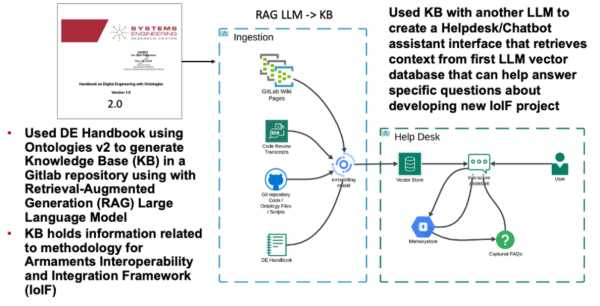
LLM Process for Developing the Knowledge Base and Help Desk/Chatbot
“The Help Desk / Chatbot capability is essential and will be greatly beneficial to DEVCOM-AC as part of the software knowledge transfer since DEVCOM-AC software developer can quickly ramp up on IoIF source code for its software lifecycle maintenance and sustainment.”
– Weng Gei Wong
Benefits
The robust User Interfaces (UI) developed by the SERC team ensure easy operation and promote adoption among DEVCOM-AC users.
The culmination of all the research tasks will deliver a Digital Engineering Ecosystem that can be deployed on the Army network and be maintained by DEVCOM-AC. This ecosystem will support workforce development for DEVCOM-AC personnel and that of other affiliate organizations.
Advancing DEVCOM-AC capability and workforce skill through cutting edge technologies supports rapid development of interconnected solutions to DE challenges and of intelligent armaments for an ever-changing battlefield.
“IoIF has great potential for realizing an AI capability like ‘Microsoft Co-pilot’, by developing a DEE chatbot capability using IoIF and LLM that can allow users to query a digital thread data in a knowledge graph using a natural language instead of SPARQL query.”
– Weng Gei Wong
Follow SERC on LinkedIn for regular updates on systems engineering research.